- AI in Design
- Automotive UX
- Teardown
Tesla Reality View: your car doesn't draw the road anymore. It paints it.
“FSD is GTA irl.”Elon Musk on X, Nov 22, 2026
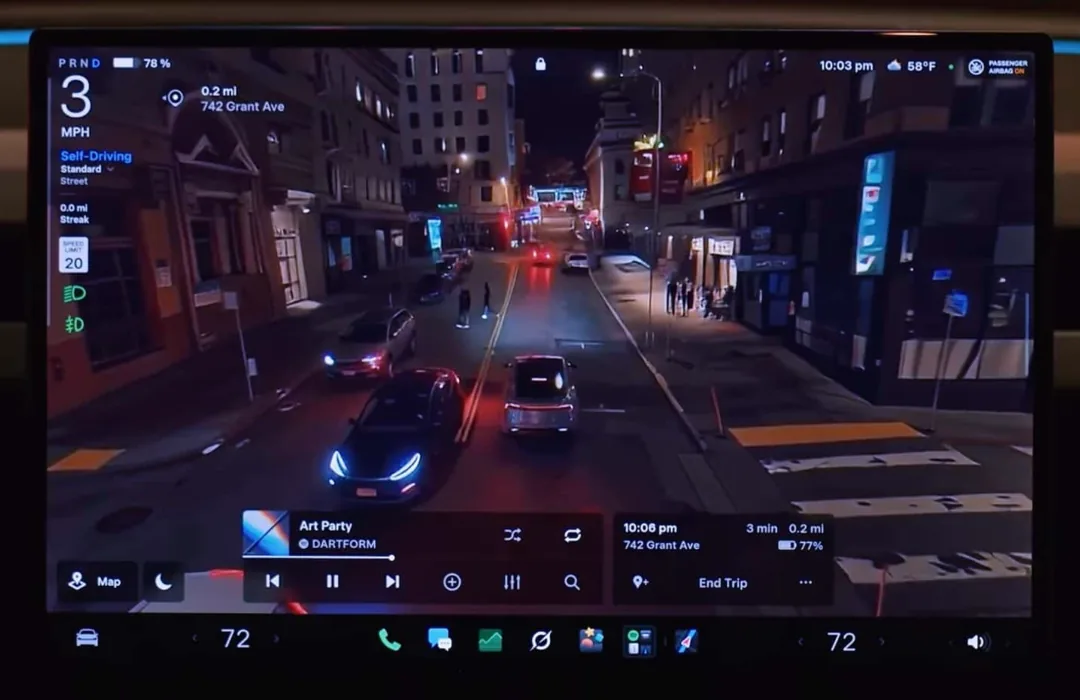
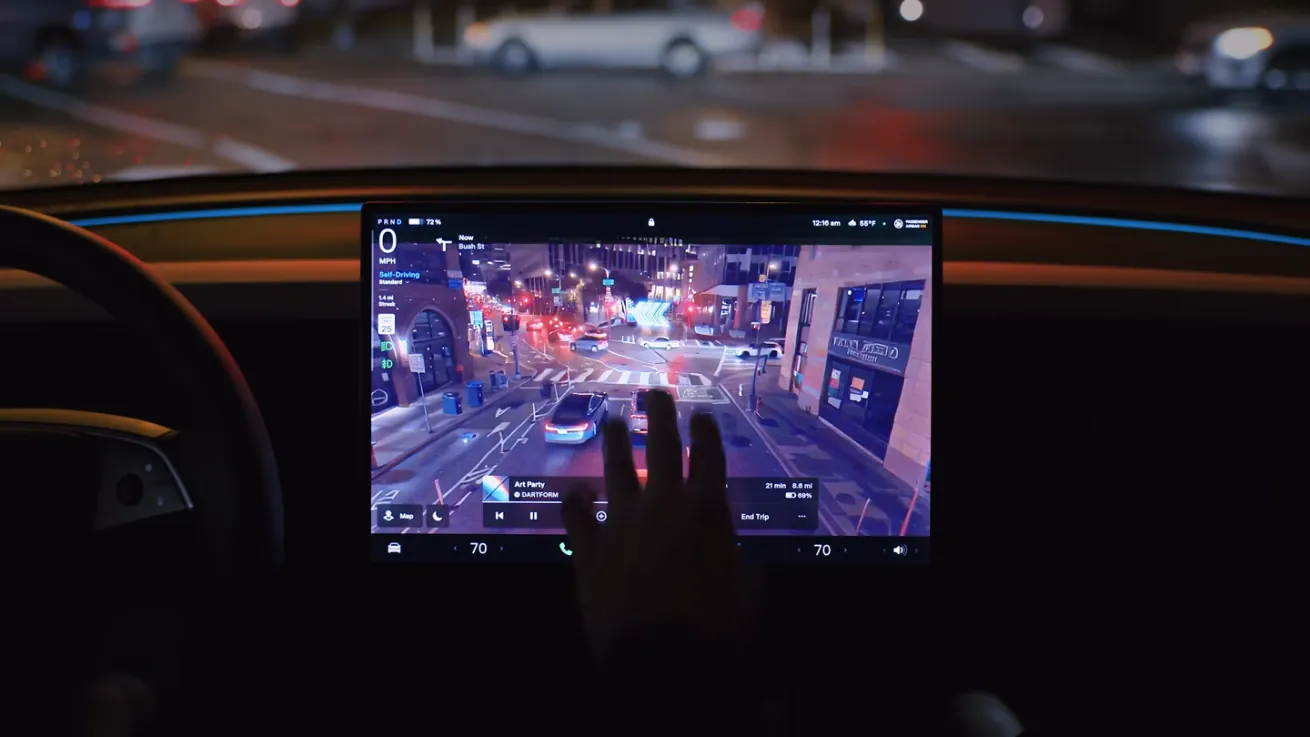
- Chase camera. A virtual viewpoint above and behind your own car.
- Painted world. Neon signs, shop fronts and streetlights, generated live rather than pulled from an asset library.
- People and traffic. Pedestrians and parked cars drawn as they are, not as icons.
- Next turn. Route guidance stays pinned while the scene moves.
- Map. One tap swaps the generated view for the classic map.
- Quiet mode. The moon icon trims the screen to fewer elements.
A screen that stopped drawing and started imagining
On November 21, 2026, Tesla began rolling out Full Self-Driving (Supervised) v15 to Early Access members (ZeroHedge). The headline wasn’t the driving. It was the screen. Within a day owners were posting their car rendering wet-road reflections, a billboard downtown and the Christmas lights on a neighbour’s house.
Tesla calls it Reality View and describes it as a real-time generative driving visualization, streamed from a virtual camera above the car. That word is the story. For six years the display drew the road: perception detected objects, and an engine placed a 3D model where each one was. Reality View places nothing. A neural network paints every frame.
Symbolic UI tells you what the system detected. Generated UI shows you what the system imagines. They earn trust in very different ways.
That shift, from symbolic to generated interface, is coming to every product where an AI acts for someone. So let’s take the car’s screen apart.
From grey boxes to a generated world
Reality View is the third rendering approach Tesla has shipped, and each one changed who does the drawing. Early FSD screens sat on dark backdrops with surrounding traffic as simple, boxy shapes (Yahoo Autos), running on the open-source Godot engine (Teslarati).
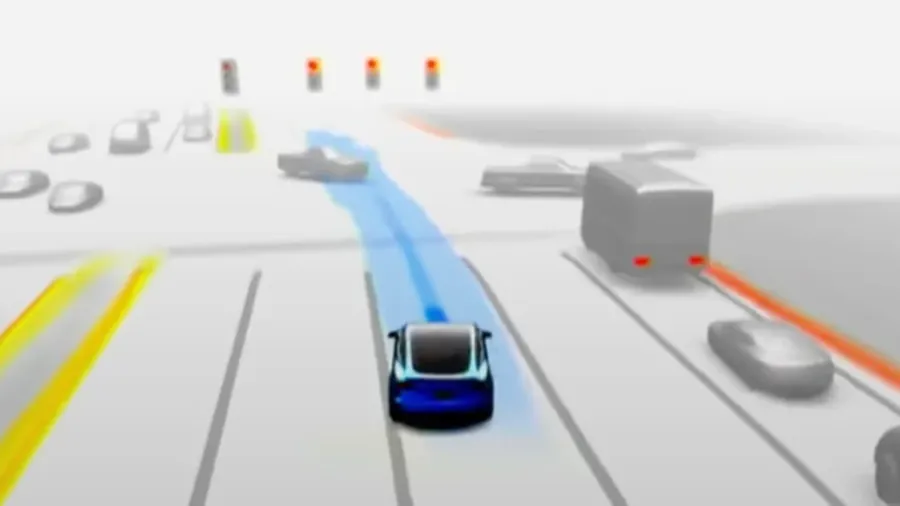
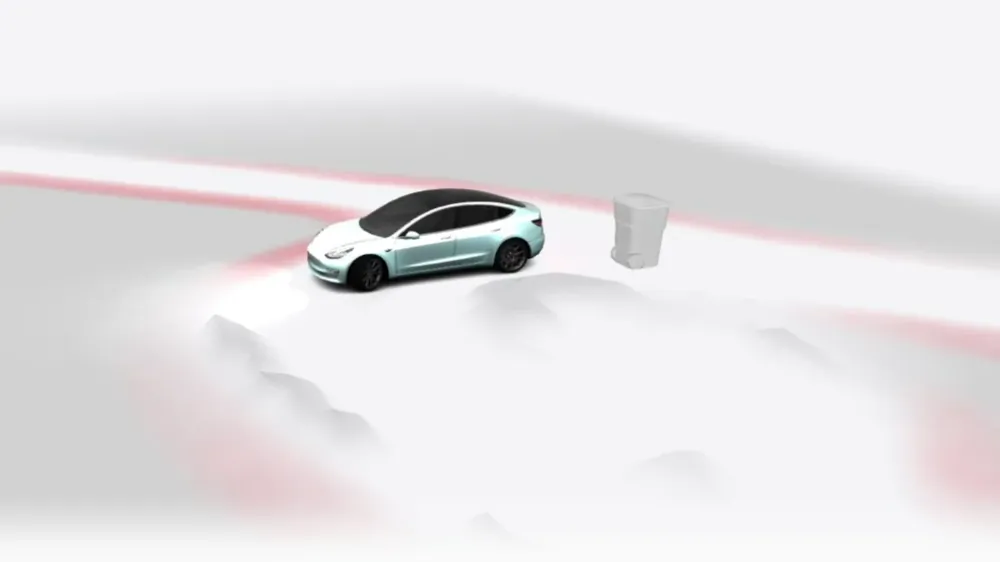
2019–2025 · Godot
The asset library
Each detected class gets a stock model. Unknown objects become a generic debris pile.
Image: Not a Tesla App
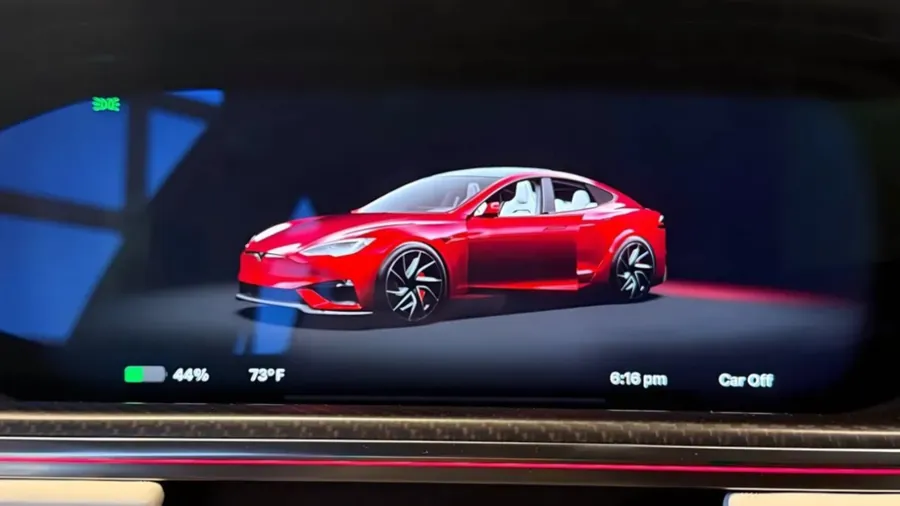
2026.14 · Unreal Engine
Better models, same idea
Vehicles move to Unreal with real lighting. Still a library of pre-built assets.
Image: Not a Tesla App
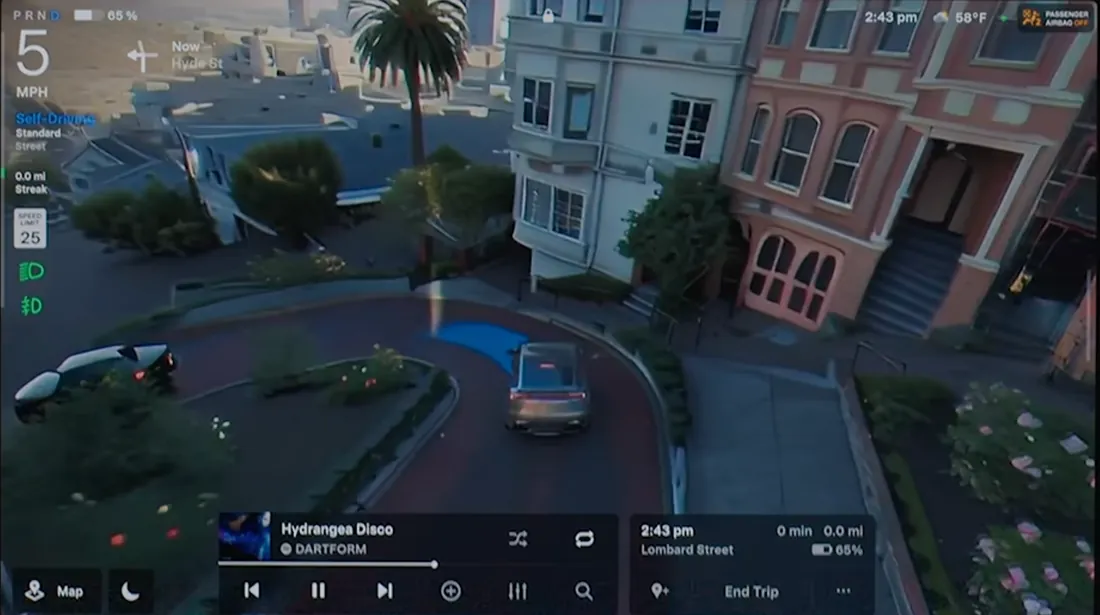
Nov 2026 · FSD v15
A generated world
No asset library. A diffusion model paints whatever the encoder's features carry.
Image: Tesla launch video
Evolution — three rendering eras, illustrative
| When | What changed |
|---|---|
| Nov 21, 2026 | FSD v15 ships Reality View, a generative overhead view of the drive (InsideEVs) |
| Mid 2026 | Update 2026.26 retunes lighting after the Unreal switch made car colours look off (Not a Tesla App) |
| 2026 | Update 2026.14 moves vehicle models to Unreal Engine (same source) |
| Aug 2025 | Hacker greentheonly finds Unreal code in firmware 2025.20, first on AMD Model S/X (Not a Tesla App) |
The asset model had a hard ceiling. Anything without a 3D model either vanished or became a stand-in: a “dog” model covered similar-sized animals, and unidentified objects showed as a debris pile that didn’t match the real shape (Not a Tesla App). Every new thing the car understood needed someone to build an asset for it. Reality View removes the ceiling.
How it works: one set of eyes, two brains
Reality View is neither a camera feed nor a game engine. It is a second neural network that reads the same perception data as the driving network, then generates an image from it. Musk laid out the architecture on X a day after launch, as reported by Teslarati and Not a Tesla Killer.
- CamerasLive video
- Vision encoderUVE · FSD · Robotaxi · Optimus
- Driving model~3B parameters
- Reality View model~1B · diffusion · half a TRIP chip on AI4
- Large world modelOff-car · training data
- Car controlsSteering, speed, path
- Centre screenWhat the driver sees
Pipeline — as described by Musk, Nov 22, 2026 · parameter counts approximate · last frame + noise → next frame
Two design consequences fall out of this. Because the painter reuses features the driver already computes, Tesla says Reality View uses less total compute than the display it replaced (Kingy AI). And the screen is now coupled to the driving system’s perception, not to a separate graphics pipeline. You see a rendering of what the encoder encoded, not a hand-curated object list.
The frame loop: why it doesn’t shimmer
Early AI video flickers because each frame is generated from scratch. Reality View avoids that with a simple trick: it starts every new frame from the last one. The painter adds noise to its previous image, then denoises it, steered by the freshest encoder features. Most of the scene carries over; only what changed gets repainted.
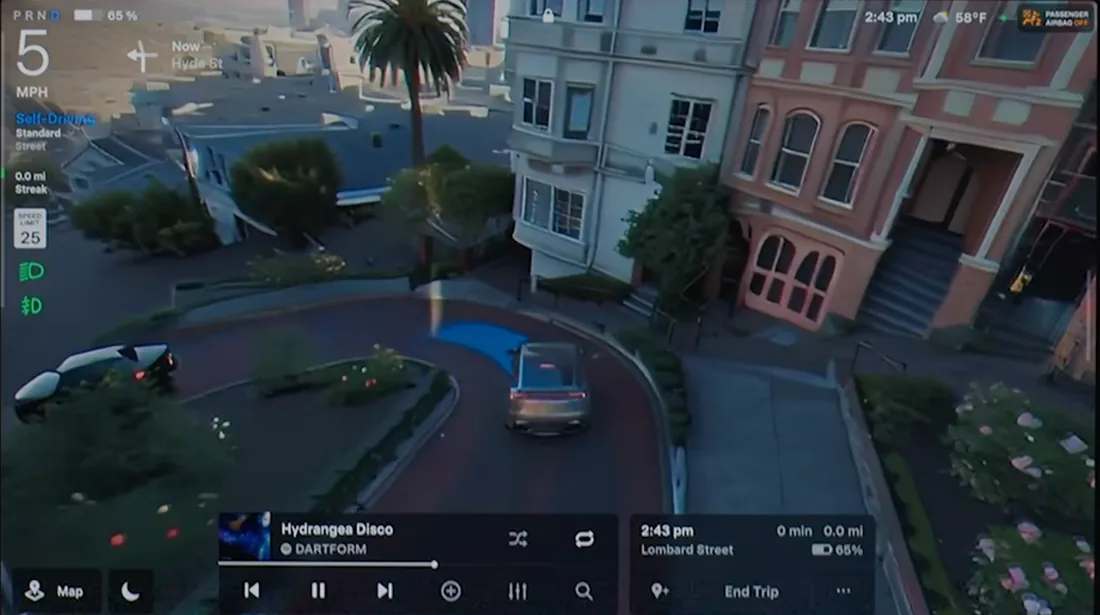
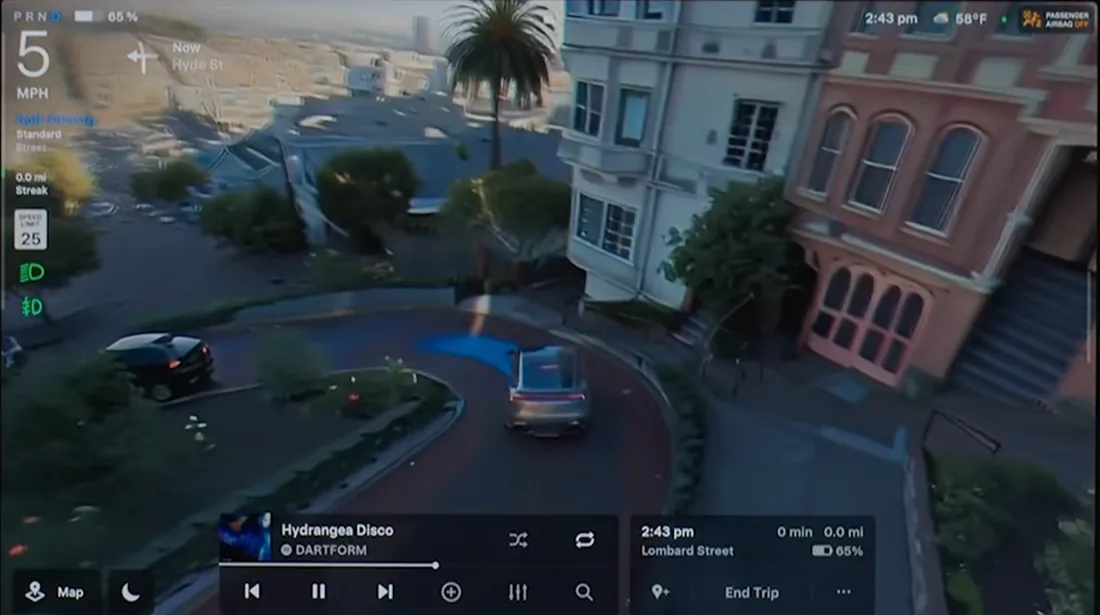
- Last frame. The image already on screen.
- Add noise. Loosen it so it can change.
- Denoise with fresh features. Recent UVE features steer what the noise resolves into.
- New frame. The camera has moved on and the parked car has slid back; the street itself held steady.
- 18Hz
- Encoder frames processed
- 4 cycles
- To spread the work per frame
- 8 images
- Per output chunk
- ~36fps
- Derived from Musk's figures, not measured
Frame loop — real frames from Tesla’s V15 launch video (0:17–0:18) · the noise is our illustration of the process · figures via Not a Tesla Killer
The figures come from Musk’s description: the painter processes each encoder frame at 18 Hz, spreads the work across four cycles and outputs chunks of eight images. Not a Tesla Killer works that out to roughly 36 frames a second. The painter itself is a shrunken sibling of something much bigger: Musk says Tesla has had a near pixel-perfect world model since last year for synthetic training data, and the in-car model is a much smaller version of it (Teslarati).
The interface: a grammar borrowed from games
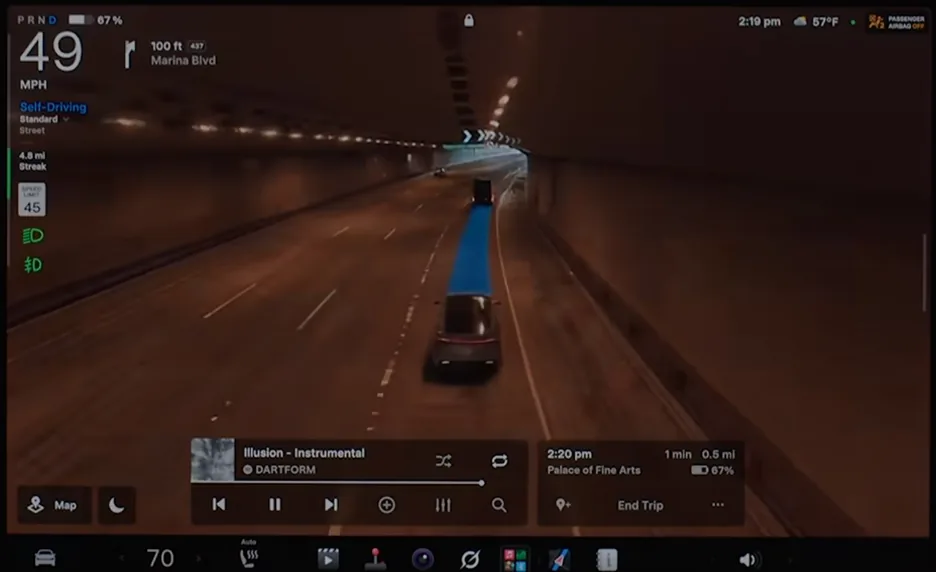
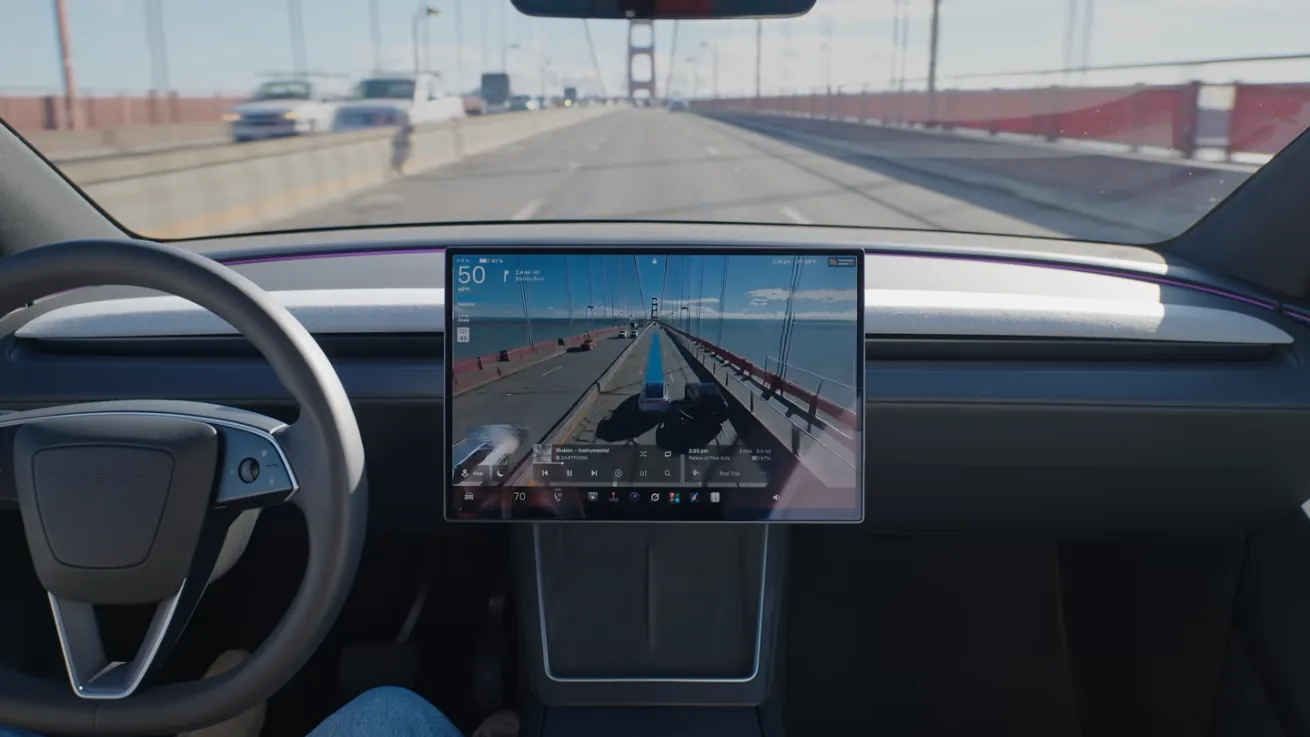
Strip away the rendering and Reality View is a set of deliberate interaction choices. Most of them borrow from a visual language hundreds of millions of people learned in open-world games. All three frames below come from one drive in Tesla’s launch video.
Reality View 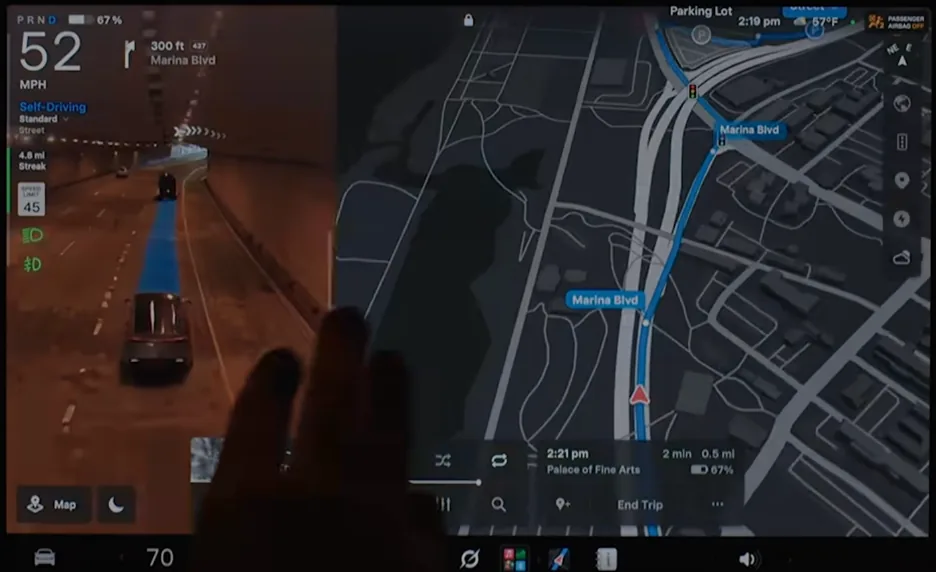
Split 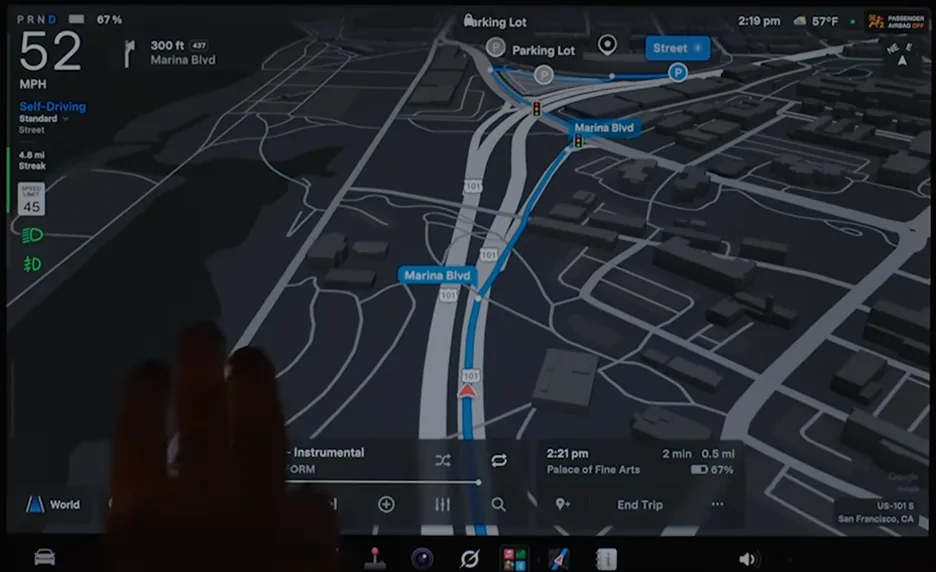
Map
Layout modes — three frames from one drive · Tesla V15 launch video, 0:20–0:21
| Element | What it does | Design job |
|---|---|---|
| Chase camera | Virtual viewpoint above and behind; drag to swing it around | Own position and surroundings in one frame |
| Turn arrows | Arrows and chevrons hang over the next turn or roundabout exit | Shows intent, not just perception |
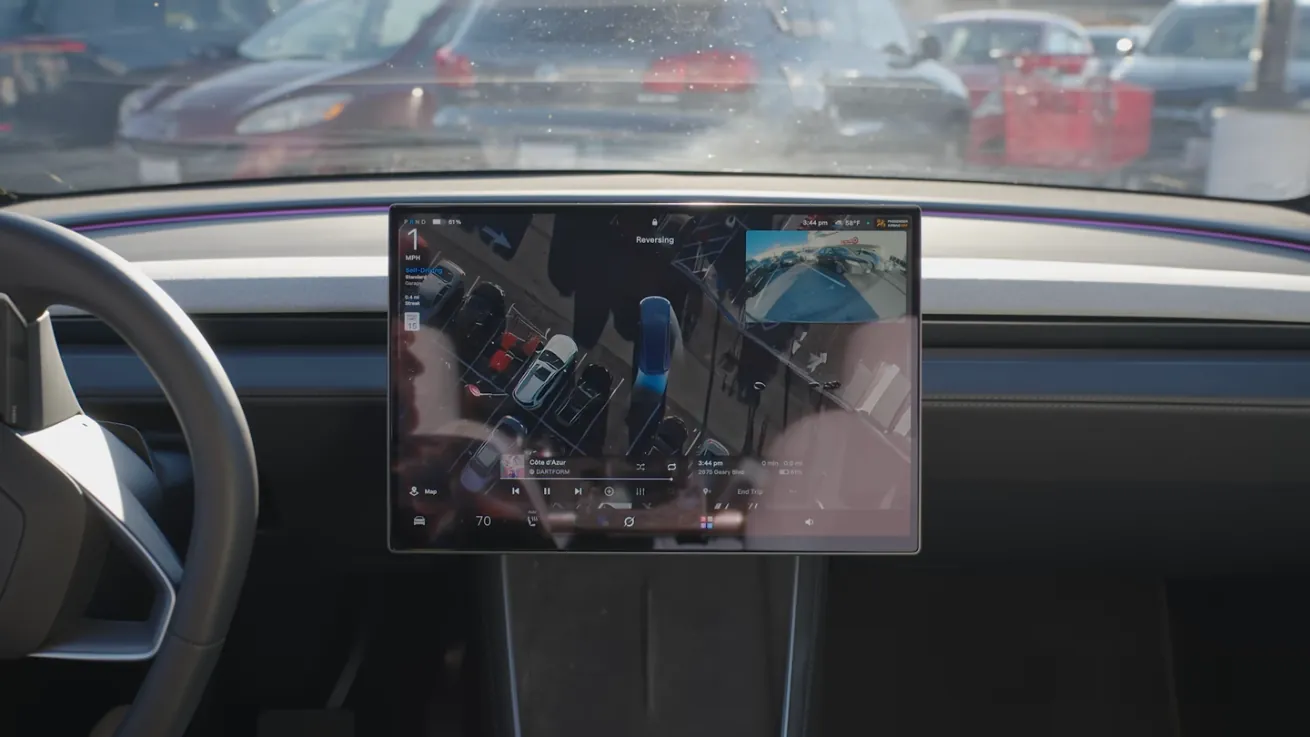
| Parking chevrons | Open bays appear as chevrons; the chosen one gets three, and the view drops to bird's-eye | Choice, confirmation and re-framing |
| Layouts | Full screen, map, split, plus swiping to the classic map | Driver sets world vs. route |
| Quiet mode | A moon icon trims the screen; turn-signal clicks fade after a few | Calm technology on long drives |
| Tap to drive | Musk demoed tapping a point to send the car there | From watching the AI to steering it |
Sources: InsideEVs, Kingy AI, Basenor.
The camera is the biggest decision
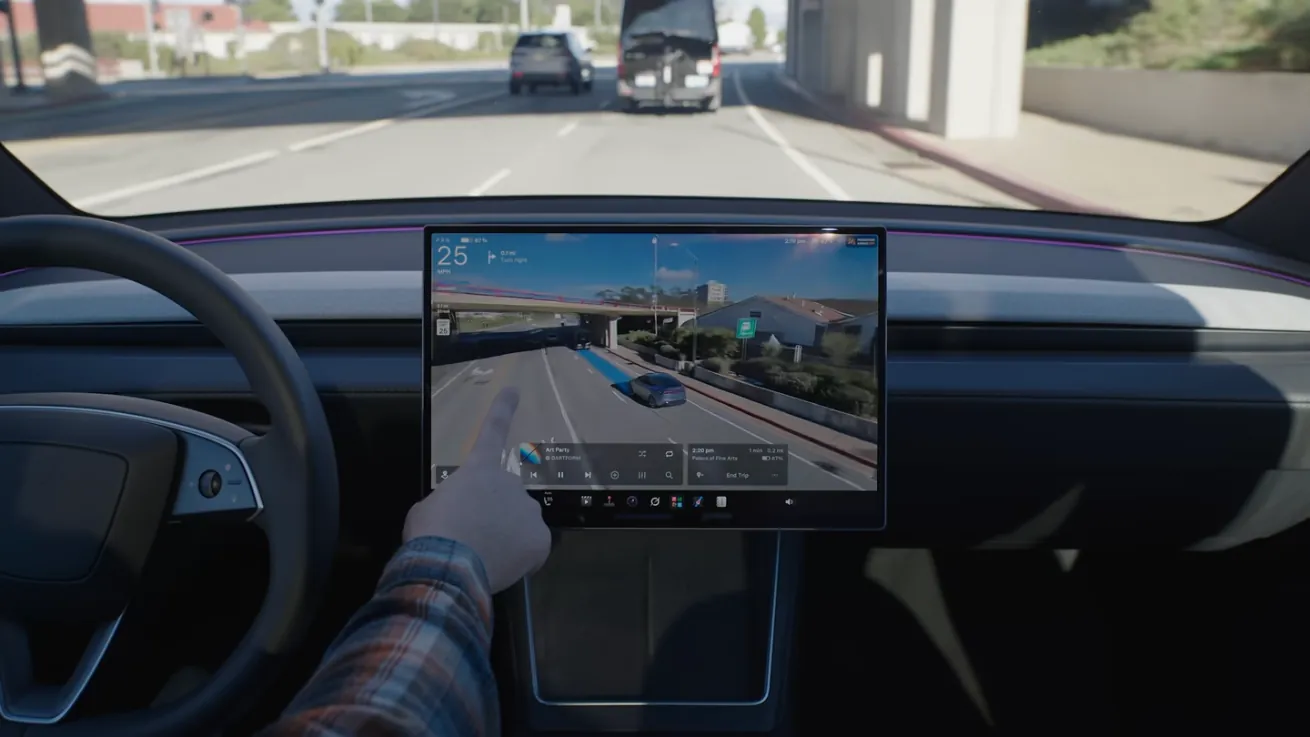
A third-person chase cam is a game convention for a reason: it shows your own position and the space around you in one frame. That is exactly the mental model a supervising driver needs. The old top-down view answered “what’s near me?” The chase cam answers “what’s near me, and where am I going next?”
Intent moved into the world
The planned turn used to live on the map. Now it floats over the actual intersection, in the same space as the cars and curbs, much like BMW’s Augmented View navigation (Yahoo Autos). Putting the plan where the action is removes a mental hop between two screens.
From watching to steering, almost
Tesla frames Reality View as letting drivers see and control what FSD plans. That turns a status monitor into an input surface. It isn’t there yet: early owners found tapping didn’t change the selected parking spot, and Sawyer Merritt had to drive manually before a parking prompt appeared (Kingy AI).
Both frames: Tesla V15 launch video.
The trust paradox: the more real it looks, the more it has to be right
The goal of any autonomy display is calibrated trust: the driver should trust the system exactly as much as it deserves. Reality View makes the display far more convincing. That is only a win if it is also more accurate, and a generative renderer adds three new ways to fall short.
1. Latency
Teslarati’s first drives found some input lag when dragging the camera, and a scene that trails the windshield by a fraction of a second; it felt less responsive than older visualizations. Musk blamed compute limits and proposed feeding fresher encoder features deeper into the denoising process, which he estimates cuts about 35% of the lag with no new hardware (Teslarati).
- Today
What you see through the windshield has already happened by the time Reality View paints it.
- With the proposed fix
Fresher features enter the denoising later, closing an estimated 35% of the gap on the same hardware.
Latency — illustrative · Tesla hasn’t published a lag figure
For a supervising driver, a beautiful frame that is a beat old can be worse than an ugly one that is current.
2. Hallucination
A diffusion model produces the most plausible image for its inputs. Usually that is the truth. As autonomy researcher Missy Cummings told InsideEVs in an earlier piece on FSD, wherever there’s a neural net, hallucination is possible. Research on generative driving world models finds the same tension: the most realistic-looking models often break physics, while geometrically stable ones look less real (WorldLens). One early claim says Reality View can show a clear scene through fog (Basenor). It’s unverified, and it’s the case to worry about: a crisp, confident picture of a road the cameras can barely see.
3. Realism signals certainty
The old debris icon was ugly but honest; its abstraction said “something is here, I don’t know what.” Photorealism removes those visual hedges. Tesla says Reality View folds the model’s separate explicit signals into one end-to-end visualization (Not a Tesla Killer). Clean for the eye, but “detected,” “planned” and “unsure” now share one painted surface.
Rendering fidelity → photoreal, across · system confidence → high, down
Undersells
Abstract and sure
The system knows exactly what's there but shows a grey box. Safe, just under-informative.
Old car modelsCalibrated
Real and sure
Rich detail the system actually perceived. Where Reality View shines.
Clear daytime streetHonest
Abstract and unsure
Low fidelity admits low knowledge. The shape itself is the hedge.
Debris-pile iconDanger zone
Real but unsure
A photoreal frame over weak evidence. Looks certain, isn't. Design must flag it.
Fog claim, unverified
Fidelity × confidence — our framework · placements are illustrative
There is also a plain attention question. A screen people describe as a video game is, by design, nice to look at. FSD v15 is still Supervised, and the display is no substitute for eyes on the road. Access is limited too: early coverage ties Reality View to HW4 (AI4) cars, it isn’t available in Europe, and HW3 support is unconfirmed. Musk has pointed to a wider release in December without market dates (Not a Tesla Killer, Kingy AI).
Six lessons for anyone designing AI interfaces
You don’t need to design for a car to learn from this. An agent booking travel, a copilot editing a document or a model triaging tickets faces the same problem: show the human what the machine understands, and what it’s about to do.
Borrow a grammar people speak
Tesla took the chase cam and floating waypoints from games, so the screen felt readable on day one. Look for a metaphor your users already know.
Show intent, not just perception
The most useful pixels are the arrows over the next turn. “Here's what I see” builds curiosity; “here's what I'll do” builds trust.
Match fidelity to confidence
Realism reads as certainty. When the system is unsure, the interface needs a way to say so: a softer render, a ghosted state, an explicit flag.
Freshness beats beauty
A delayed, gorgeous frame is a lie about the present. In real-time AI surfaces, latency is a design spec. Decide what you'll drop to stay current.
Explain from the real internals
Reality View is painted from the same features the driver uses. The explanation should come from the system's actual state, not a story layered on top.
Give people the dial
Full screen, split, map, quiet. Different moments need different amounts of machine visibility. Keep the calm option one tap away.
The road ahead
“GTA in real life” is great marketing, but it undersells the change. Tesla stopped treating the in-car display as a graphics problem and started treating it as a model output. The screen is no longer a picture of a list of objects; it is the perception system’s own imagination, made visible.
The next releases will show whether Tesla closes the latency gap, whether owners catch the painter inventing things, and whether the interface learns to show doubt as clearly as it shows Christmas lights. For designers, the takeaway is already here: generated interfaces are arriving, and the craft is shifting from drawing every state by hand to deciding what an AI should be allowed to show, and how honestly.